

While we’ve chatted all about great dialogue this year, we haven’t yet covered how to make it great between people. Yes, individual characters gotta have personality, rich inner lives, and convincing body language. But for dialogue to become more than just plot business—for it to become a sparking, crackling set of volleys that fill the story with irresistible color and texture—they’ll need something in particular.
They’ll need chemistry.
Character chemistry, | ˈkeməstrē |, noun: the complex emotional interaction between two characters that changes each of them over the course of the story.
It’s complex because it’s made of so many components, but in its basest form (chemistry joke!), character chemistry is literal, actual chemistry.
That is, it’s taking characters’ defining elements and combining them to form something completely different for each character. This is true whether it’s romantic or platonic chemistry!
Look at this graphic I made with my own two hands, a real illustrator, and knockoff Photoshop, because I dislike pouring a bottle of water out onto the ground each time I need a visual:
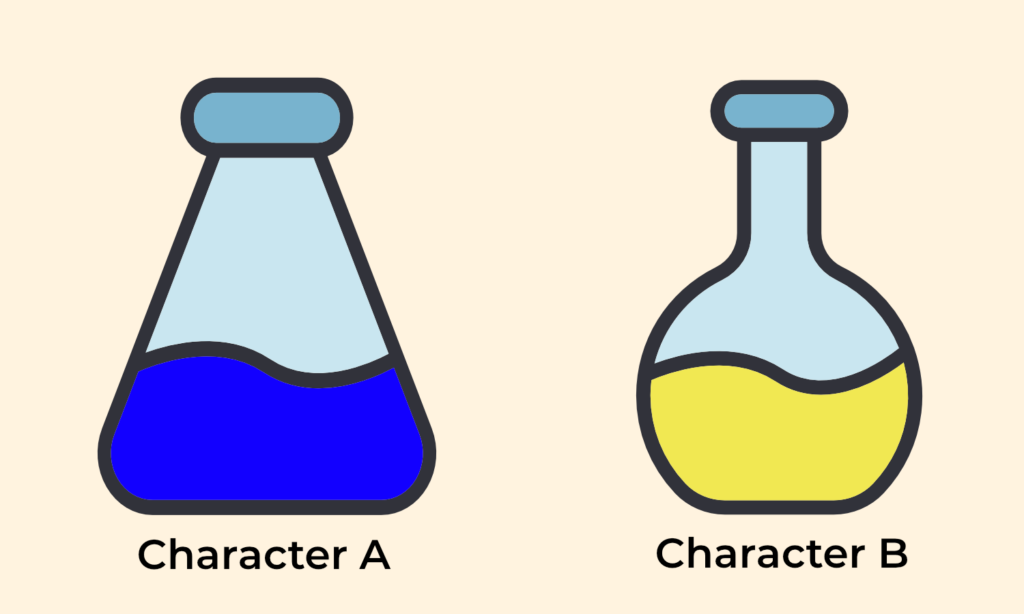
These characters each have their own chemical makeup, or colors. The colors represent who these characters are: their past, values, beliefs, and goals, combined to give them a personality. Before Characters A and B meet, they’re separate people with their own colors, their own ways of thinking and doing.
Then…
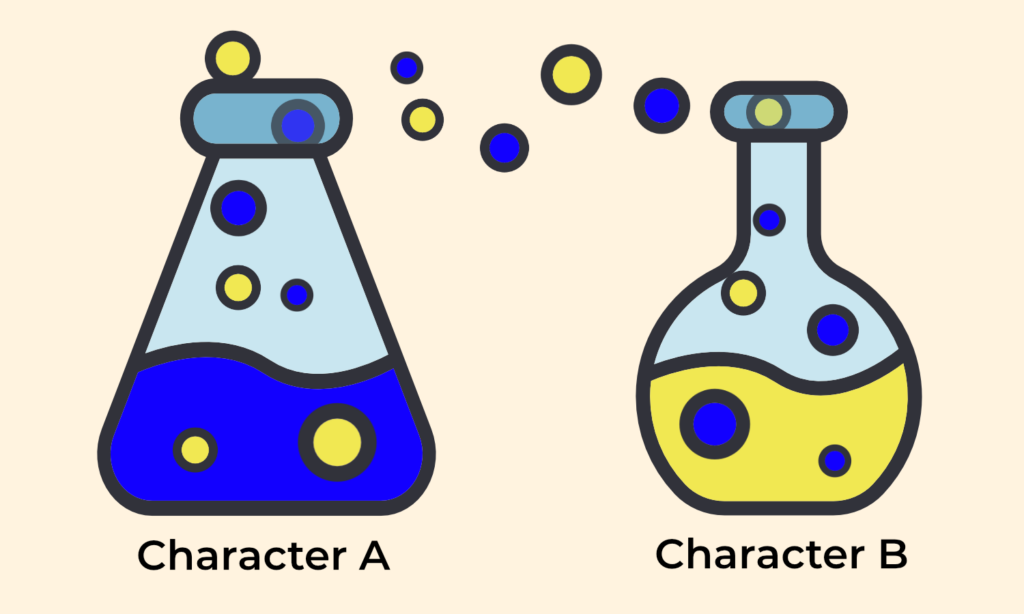
Then you put these characters in situations where they need each other to survive. Or solve the mystery. Or save their family. Whatever! They fight the antagonist. Maybe they fight each other. Along the way, they’ve got no choice but learn things about one another. That learning means their colors start to mix and combine. And because they’re different people with different ways of thinking and doing, those combined colors create tension and friction.
Until…
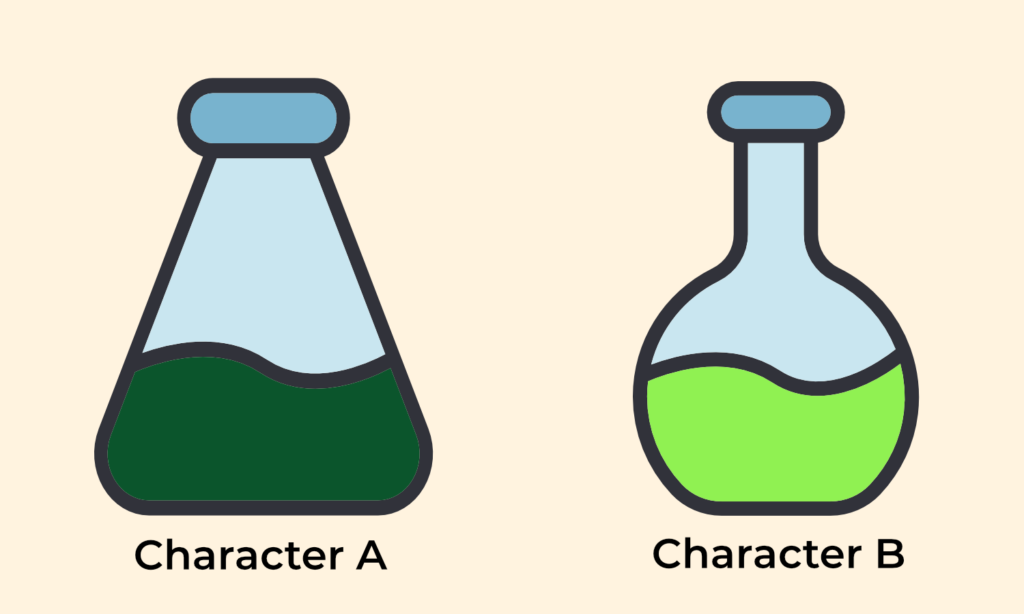
Learning leads to understanding, filling each character with new perspective about the other person. They might even like what they see, and they certainly respect it. By the end, that new perspective changes them both, causing each of them to take on characteristics of the other. They retain elements of themselves, of course—hence a little yellow in blue creating a darker green, and a little blue in yellow creating a brighter green. But they’ve changed. They use what they’ve learned about each other to change themselves, and it helps them save the day.
TL;DR:
When when characters’ differences rub up against one another, this creates friction. The close proximity of friction means they learn more about each another, sparking new understanding and causing them to take on traits of the other. That change empowers them to challenge the antagonist and win the day.
That’s it. That’s character chemistry. I could end the article right here!
But I love nothing so much as breaking stuff down to their atoms, so let’s delve into actually creating characters and stories where the colors can change in the first place. Then we’ll do some examples. Oooh, I love me some examples.
HOW TO CREATE GREAT CHARACTER CHEMISTRY
- The characters gotta be deep. You simply can’t have chemistry between characters who only have characteristics (surface-level traits like shy, secretive, defensive) instead of distinct personalities (deeper context that demonstrates why those characteristics exist). Characters with characteristics only give us quips that anyone could say, teaching us nothing about them. Characters with distinct personalities help the reader and other characters understand where they’re coming from when they speak. This charges each line with their values, beliefs, and experiences. Per the definition above, that’s a complex emotional interaction. (Whether or not they like that person because of those things is up to you.)
- A note on character arcs: characters are strongest when they grow and change throughout a novel. Some of that change can be because other people help them see ways they need to grow and change. That creates chemistry!
- A note on character arcs: characters are strongest when they grow and change throughout a novel. Some of that change can be because other people help them see ways they need to grow and change. That creates chemistry!
- The characters gotta need each other for something plot related. Not need in a general sense, like, “we have to go on this journey together,” but actual high-stakes need, like, “We have to go on this journey together or the bad guys will turn us into flesh confetti.” “We have to work together because you know the way out of this cursed maze and I know how to defeat the bad guy at the end of it.” “We’re the only two people who know how to steer this brigantine and the crew will kill us if we don’t.” The threat the characters face if they don’t work together has to be big. One of the central points of the novel, if not the central point. Make them absolutely critical to one another!
- Their differences end up changing one another. They can have things in common, and even should. But the differences in their personalities should be a source of friction, misunderstanding, incorrect assumptions, or other discord as they realize each of them has different ways of solving the problem in front of them. As they learn more about one another’s personalities and those differences help save the day, they come to respect those differences, even emulate them. They both change! Their colors change!
- Respecting those differences can come across in a few ways, including but not limited to: Character A deciding to rely on Character B’s abilities when before, A would have sooner dropped dead; Character C trusting Character D with critical information that leads to a plot breakthrough; Character E lets Character F take charge of something super important to E; all of this in vice versa.
- Emulating those differences can look like: Character A reluctantly using one of Character B’s signature moves—and it works; Character C’s ideologies change based on how Character D lives their life; Character E takes more risks thanks to Character F’s encouragement, and it works out.
- A note on their different walks of life: When there’s a difference between characters’ privilege, rank, ability, etc, they still need to (eventually) see each other as equals.
- A note on their different walks of life: When there’s a difference between characters’ privilege, rank, ability, etc, they still need to (eventually) see each other as equals.
- OPTIONAL: The characters are singular to one another. Okay, use this or not, but it can certainly add a hell of a lot of yearning and/or tension to romantic and platonic chemistry. Nothing fosters understanding and respect like being the only person who can do something for someone else. And what I mean is stuff like this:
- Character A is the only person who knows B’s secret—and has kept it.
- Character C is the first person to ever look at Character D and see more than just royalty. Make it fit your story: more than just their job, their past, their mistakes, their scars, their vice.
- Character E treats Character F the same as E would anyone else, and F is grateful for it
- Character G is the first person who ever encouraged Character H to do what H wants, not what everyone else wants for H. Make it fit your story: G is the first person who ever encouraged H to take the chance, to try again, to leave what isn’t serving them, to trust themselves.
- Character J is the only one who sees the good in Character K, which inspires K to try to be as good as J thinks
This shit is addictive. Do you hear me? Is this thing on? This is the stuff that turns casual readers into evangelists for your story.
Now let’s see how it looks when you apply it to examples.
EXAMPLES OF GOOD AND BAD ROMANTIC AND PLATONIC CHEMISTRY
We’re gonna go with Star Wars here, both the prequel and original trilogies, because either you’ve seen them or have access to them, and it’s got great and not-so-great examples of chemistry. The bits in bold below reference the how-to section above.
Good Romantic Chemistry: Leia and Han
Leia and Han are about as individual as you can get: a noble princess charged with a righteous goal and a sense of duty to it, and a snarky smuggler who only looks out for himself. They’ve got strong, distinct personalities, almost polar opposites of each other—meaning the story is set up so they can meet in the middle.
- They’re thrown together when everybody’s mission goes awry and suddenly they need each other to survive. The strength of their personalities means they clash right away: Leia clocks Han’s scoundrel tendencies from minute one, and is furious she has to depend on a selfish jerk for a rescue. It goes against everything she stands for! Han, meanwhile, can’t believe he’s risking his life for someone who immediately takes charge of the rescue herself, throwing his self-aggrandizing attitude into total disarray. It goes against everything he stands for!
- Look at how those molecules and colors begin to combine. Han Goes Through It with both Leia and Luke (more on Luke below), learning about them, beginning to respect them—which causes him to take on a little bit of Leia’s sense of duty, and he returns to help Luke save the day for the rebellion at the end of A New Hope. Meanwhile, Leia takes on some of Han’s personality, too. You can’t tell me a noble-hearted leader isn’t conflicted about falling for a subordinate, but she goes for it because she wants it for herself, a distinctly Han-like move. She takes on some of his moxie, too. Would the Leia at the beginning of A New Hope attempt the rescue in Return of the Jedi full of secrecy, deception, and risk—especially when she’s the face of the rebellion? Methinks no.
- Leia takes on more of Han’s gambly risk-taking. Han takes on more of Leia’s selflessness. They change one another, and that change is chemistry.
Poor Romantic Chemistry: Padme and Anakin
Padme’s a working woman with no time for nonsense and a galaxy to save. Anakin’s a Jedi who can’t follow his order’s precepts and has a big ol’ crush. They both generally believe in justice and using their abilities for good. Their personalities aren’t quite strong enough, distinct enough, for chemistry, mainly because we don’t know much about the events that shaped them (like Anakin’s first ten years of training, or what drove Padme to become queen at age 14). While you don’t need characters to be polar opposites to have chemistry, what we know about them is so incongruent that chemistry was never an option.
- Anakin is charmed by Padme to the point of obsession, but she’s merely flattered, uninterested in pursuing a relationship with him and frankly weirded out at some of his behavior. They’re thrown together in Attack of the Clones, Anakin as a bodyguard and she with the body that needs guarding, but anyone could do Anakin’s job, and as the film progresses, Padme doesn’t ever need a bodyguard, nor does she have any interest in his protection from the assassins supposedly after her. Anakin never needs her either, except in a spicy sense. That is to say, Anakin and Padme don’t ever truly need each other for anything, and because of that, they don’t ever have the chance to challenge one another into seeing each other’s differing perspectives.
- They’re rarely even solving the same problems! She’s focused on protecting her constituents and fighting corruption; he’s focused on proving he’s ready to become a Jedi Master. Leia and Han looked at the same situation through their different lenses; Anakin and Padme aren’t even looking in the same direction.
- As a result, they lack chemistry. Neither takes on any traits of the other person; neither person changes with the help of the other. They change a little (I could go on about their shallow character arcs), but independently of one another. No chemistry! No molecules in each others’ molecules! No colors in each others’ colors!
Good Platonic Chemistry: Han and Luke
Luke’s a naïve farmboy desperate for more than his provincial life, eager to get out into the universe and fight for a noble cause. Han is a jaded smuggler who easily blends in with the worst of the worst, interested only in fighting for himself. They’ve got strong, distinct personalities that have totally different ways of viewing the world.
- The plot throws them together when Luke needs transport to Alderaan and Han needs Luke’s cash (well, Ben Kenobi’s cash, but he and Luke are a package deal) to get out of a debt. They need one another! But of course their personalities clash: Han mocks Luke’s wide-eyed reverence of the Jedi, and Luke actively chafes against Han’s selfishness. He even plays into it, telling Han he’ll be rewarded for Leia’s rescue, even though Luke has no idea such a reward might exist. It goes against Luke’s sense of self to trust a scoundrel, and it goes against Han’s sense of self to play mentor to a rookie.
- They have no choice but to trust one another, and as they learn more about each other, they come out ahead and escape the Death Star. Their molecules are getting in each others’ molecules! Luke, in his naivety, thinks that trust means Han will stick around for the final battle, and is crushed when he sees Han still planning to leave with his reward. But Han, even after Luke snaps at him, is changed by that trust. He actually tells Luke “May the Force be with you,” when a few hours ago, he was mocking the same Force. Even as he packs up to leave, his guilt is clear, because Luke (Leia too) helped him see the good in helping others. That’s why Han comes back at the end to clear the way for Luke to make the winning shot against the Death Star. Likewise, Han changes Luke, too. Would the Luke at the start of A New Hope, desperate to become a Jedi like his father, have abandoned Yoda’s training to go save a smuggler in Empire Strikes Back? Hell no! His friendship with Han (and Leia) helps him grow to see there’s more than just a singular path. That connection emboldens him to take greater risks and gambles, and in doing so, he saves the dang galaxy.
- So yes—they change each other. Han becomes more accepting of things he doesn’t understand and one of Luke’s biggest champions. Luke takes more risks and gambles, just like Han, and values more than just his Jedi training. They change one another! That’s chemistry, bay-bee!
Poor Platonic Chemistry: Anakin and Obi-Wan
At first glance, these two are set up perfectly for great chemistry: a padawan learner and a master of the Jedi arts. One ready to shirk the Jedi ways at the first sign of conflict with his beliefs, the other a stringent follower of those same ways no matter what. They feel like polar opposites whose chemistry could make them meet in the middle.
The problem is that they never do.
While it’s a poor example of platonic chemistry, it’s a great example of why characters need more than just one of the facets of chemistry listed above. Strong, distinct personalities alone aren’t enough to create great chemistry. Readers need more than just snark and disagreement!
- Anakin and Obi-Wan get thrown together early on, but not in a way where they ever need each other, and therefore not in a way they can ever change each other. The phase of Anakin’s life where he might actually need Obi-Wan (like his early training, his lack of a close parental figure) is something we never actually get to see. When we meet Anakin again in Attack of the Clones, he’s an adult who insists he doesn’t need Obi-Wan. Obi-Wan never really needs Anakin, either. Obi-Wan’s mentor asked Obi-Wan to train Anakin, totes, but Obi-Wan commits to it out of love for his mentor, not because he needs Anakin. Eventually, Anakin abandons the Jedi ways just like his personality indicated he would. Obi-Wan remains loyal to the Jedi, just like he has the whole time. These two events are entirely separate from one another.
- That lack of need, combined with personalities that never truly help each other grow, means their molecules don’t ever mix. Whatever change they undergo is in spite of each other, not because of each other. Which means there’s no chemistry!
Aaand that’s it! That’s how you do character chemistry! No actual flasks needed, thank goodness. Next time we’ll be looking at the importance of realism in dialogue, and how I think there’s something even more important than realism: purpose.
Questions? Comments? Leave ’em below or find me here or here.
Catch you next time—in September!

Leave a Reply